The Mirrored Moon
No one predicted it precisely. The solar eruptions that month were intense, yes—but nothing beyond the expected cycle. Satellites were placed on alert, airlines rerouted polar flights, and newscasts spoke of stronger auroras shimmering across the planet’s northern skies. The usual spectacle of solar violence.
What no one expected was a secondary collision—when one of those plasma bursts ejected from the Sun, charged with immense energy, crossed the asteroid belt and met a forgotten body: an ice meteor, one of those dismissed by scientists as unimportant. Fragile, yes—but vast enough to shatter into an ultrafine cosmic dust of ice. That frozen cloud was swept forward by the force of the eruption, traveling silently through our solar system until it was drawn by Earth’s gravity, drifting through the space between us and the Moon and lingering there, suspended like a transparent veil.
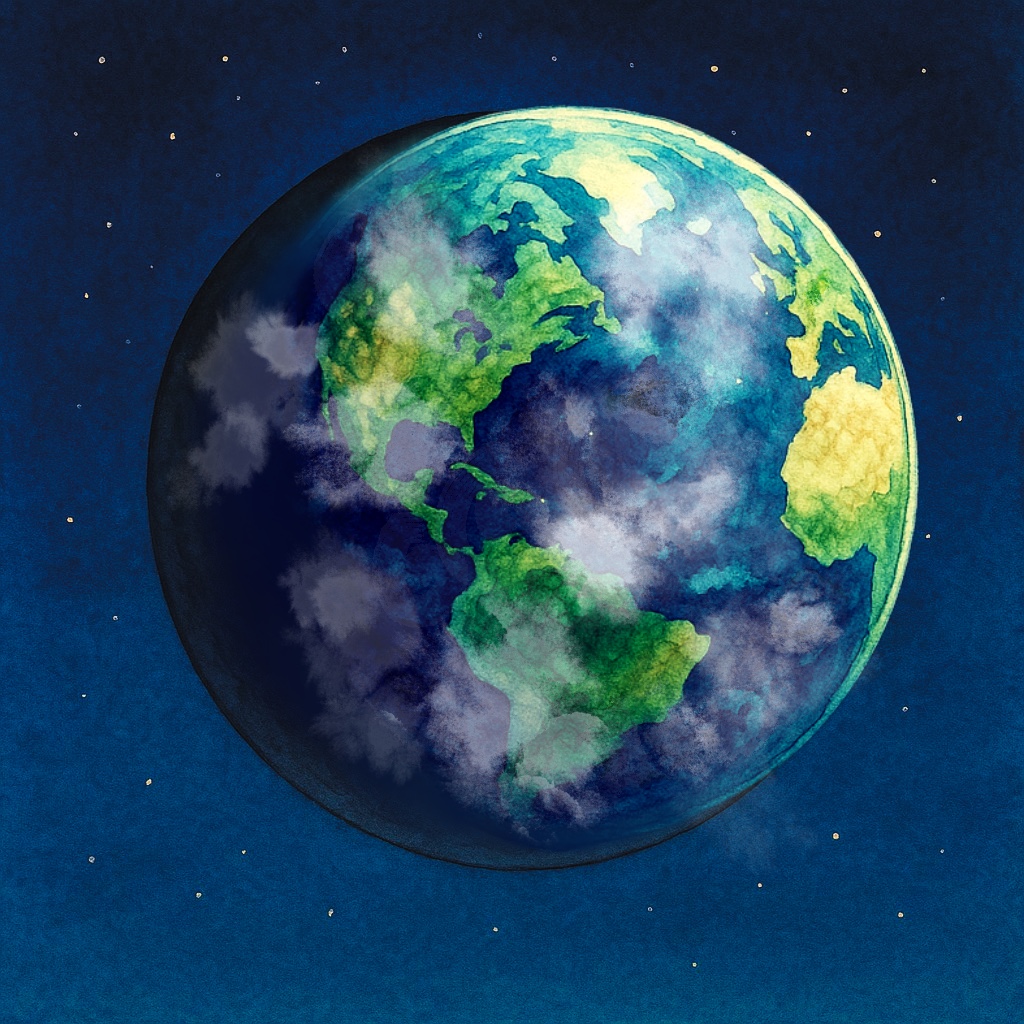
For a little more than twenty hours, the cloud crossed space, guided by the residual force of the solar flare—and on the evening of September 14, as the Moon rose in the sky, telescopes began to capture the improbable. The gray, irregular surface of the satellite, long accustomed to reflecting only sunlight, suddenly became a projection screen. For a few moments, it looked like a mirage. Then it became clear: it was Earth itself, reflected upon the face of the Moon.
Blue, green, white with clouds—slowly turning upon itself, as if some cosmic artist had painted a living portrait there. It wasn’t perfect; a small fraction of the Moon remained visible, blending with the reflected image of the Earth. But the sight was breathtaking. Every continent, every sea, the planet’s faint blue atmosphere hovering like a halo. All the grandeur and complexity once reserved for astronauts, now displayed in an unprecedented spectacle for anyone willing to look up at the sky.
On Earth, the reactions were immediate.
— First, scientific astonishment. Observatories rushed to measure the phenomenon, broadcasting provisional explanations in real time: diffraction of Earth’s light through the suspended ice cloud, a prismatic effect enhanced by the geometry of the three celestial bodies. Some compared it to a planetary-scale camera obscura—an accident so improbable that no simulation had ever foreseen it.
— Then came symbolic appropriation. Churches of different faiths proclaimed the event a divine sign. “The Earth has gazed into the mirror of creation,” declared the Pope in an emergency broadcast. Across Asia, Buddhist temples lit lanterns and held silent vigils. In New York, the screens of Times Square displayed the lunar reflection beside live images of the Earth itself—creating a mirror within a mirror.
— And finally, the intimate impact. Families stepped out onto balconies, children pointed their phones toward the heavens, couples wept in silence. There was a strange feeling of vulnerability in seeing our world projected onto another celestial body—as if we were naked before the universe. And yet, the beauty of the sight reminded us of the vastness of the cosmos we belong to, of which we are a radiant, spinning fragment—colorful, fragile, and alive.
Some philosophers called that night “the grandeur of a reflection.” After all, for the first time, the entire planet had seen itself without the mediation of satellites, without digital maps, without the cold precision of Google Earth. We saw Earth not as data, but as a living image—suspended upon the face of the Moon.
The projection lasted only one night. By dawn, the icy veil had already dissipated, swept away by the solar winds. The Moon returned to what it had always been: a pale circle, stripped of visible mysteries.
But the memory remained. And perhaps it changed something forever—the unpredictability of our universe, the majesty of our planet, and the quiet awareness that we are here, as if, for a few brief hours, we had been reminded that we are one single face, reflected in the mirror of the cosmos.